Types of Pickleball Volleys: 4 Essential Shots to Control, Attack & Win Points
If you want to improve quickly in pickleball, there’s one skill you must master: the volley. Volleys are not just about hitting the ball in the air—they’re about control, placement, and strategy.
In this guide, you’ll learn the main types of pickleball volleys, when to use them, and how they work in real match situations.
Quick Answer
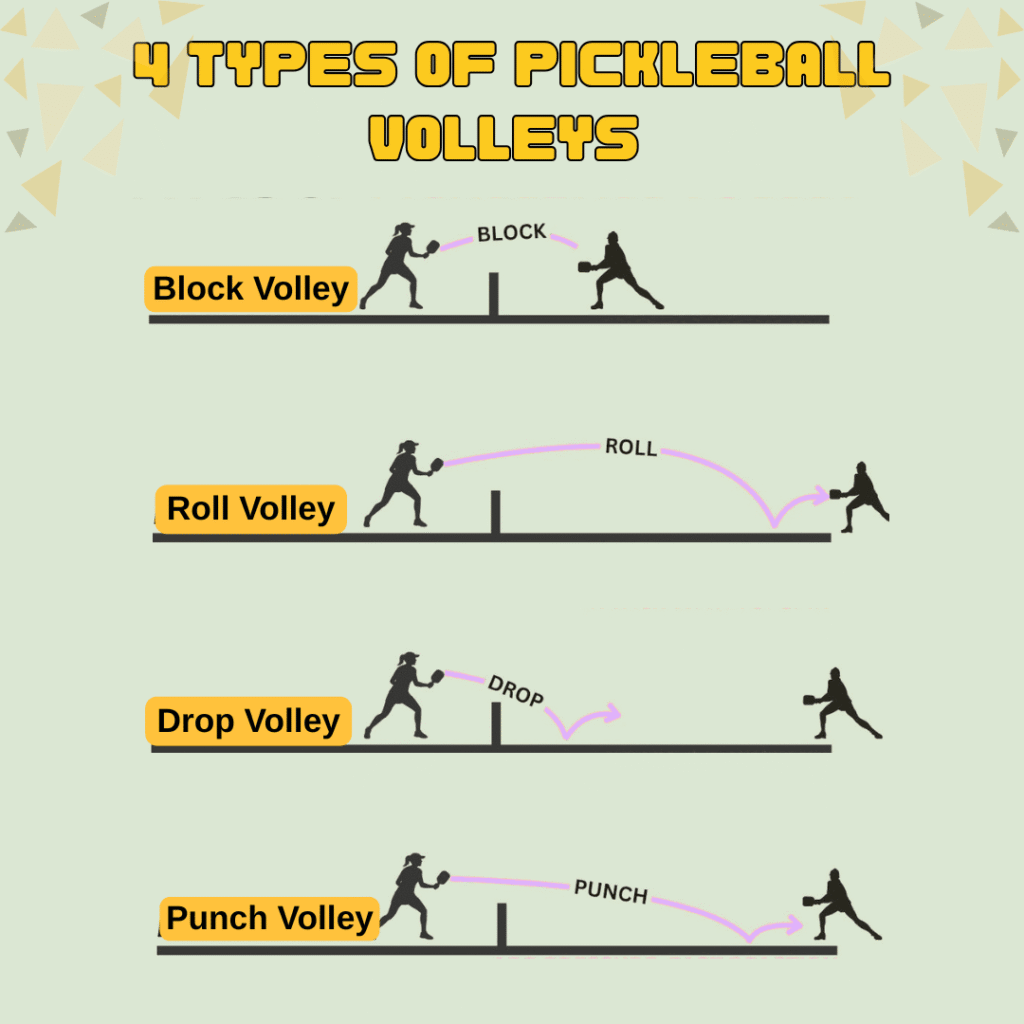
The most important pickleball volleys are: Block volley (defense), Roll volley (topspin attack), Drop volley (reset) and Punch volley (pressure shot). Each one serves a different purpose depending on the situation.
What Is a Volley in Pickleball?
A volley is hitting the ball before it bounces. Volleys usually happen at the kitchen line, during fast exchanges or when applying pressure.
► Mastering volleys = controlling the game.
Pickleball Volley Types Overview
| Volley Type | Purpose | Difficulty | When to Use |
|---|---|---|---|
| Block Volley | Defense | Easy | Fast incoming shots |
| Roll Volley | Attack | Medium | Slow or high balls |
| Drop Volley | Reset | Medium | Regain control |
| Punch Volley | Pressure | Easy | Speed up exchanges |
1. Block Volley (Defense & Control)
The block volley is your defensive foundation. The purpose is absorb power, keep the ball in play and neutralize opponents.
How it works:
- minimal swing
- paddle out in front
- soft hands
This is similar to what many call a “tennis-style volley”.
► You’re not attacking—you’re simply redirecting the ball.
When to use:
- opponents hit hard drives
- you’re under pressure
- you need to slow the point
2. Roll Volley (Topspin Attack)
The roll volley is one of the most effective offensive shots. The purpose is attack with topspin, push opponents back and create pressure.
How it works:
- low-to-high motion
- wrist acceleration
- brushing contact
This technique is similar to a “ping pong style volley”.
► The topspin helps the ball dip quickly into the court.
When to use:
- slow balls
- high balls
- weak returns
3. Drop Volley (Reset & Control)
The drop volley is all about control. Here the purpose is clearly slow the game down, reset the rally and move opponents forward.
How it works:
- soft touch
- minimal force
- gentle placement into the kitchen
► Think of it as a “soft landing” shot.
When to use:
- when under pressure
- during fast exchanges
- to regain control of the point
4. Punch Volley (Speed & Pressure)
The punch volley adds aggression. The purpose is speed up the game, apply pressure and finish points.
How it works:
- short, compact swing
- firm contact
- forward motion
► Unlike the block volley, this shot is more aggressive.
When to use:
- mid-height balls
- when you have time
- to attack your opponent’s body
Advanced Volley Technique Insights
To truly master volleys, you need to understand technique.
1. “Tennis Volley” Concept
- Simple blocking motion
- Minimal swing
- Focus on control
► Best for defense.
2. “Ping Pong Volley” Concept
- Wrist acceleration
- Topspin generation
- Aggressive mindset
► Best for attacking.
3. “Paintbrush Volley”
- brushing upward motion
- soft topspin
- controlled attack
► Ideal for mid-height balls and controlled aggression.
Choosing the Right Volley
The key is not learning one shot… It’s knowing WHEN to use each one.
Quick decision guide:
- Fast incoming shot → Block
- Slow ball → Roll
- Under pressure → Drop
- Opportunity to attack → Punch
Common Volley Mistakes
1. Swinging Too Much
Volleys require compact movement, not full swings.
2. Poor Paddle Position
Always keep your paddle in front and ready.
3. Trying to Attack Every Ball
Not every shot should be aggressive. Control wins more points than power.
Final Thoughts
Pickleball volleys are the heart of the game.
Once you understand:
- defensive volleys (block)
- attacking volleys (roll, punch)
- control volleys (drop)
► You can control pace, pressure, and positioning.